
Why auto insurance exists and what it covers
Auto insurance is a contract between you and an insurance company. You pay a premium, and in return the insurer agrees to cover certain financial losses related to your vehicle, up to the limits you chose when you bought the policy.
The core purpose is to protect people from costs that most individuals cannot absorb on their own. A single car accident can produce medical bills, vehicle repair costs, and legal liability that easily reach tens of thousands of dollars. Insurance spreads that financial risk across many policyholders.
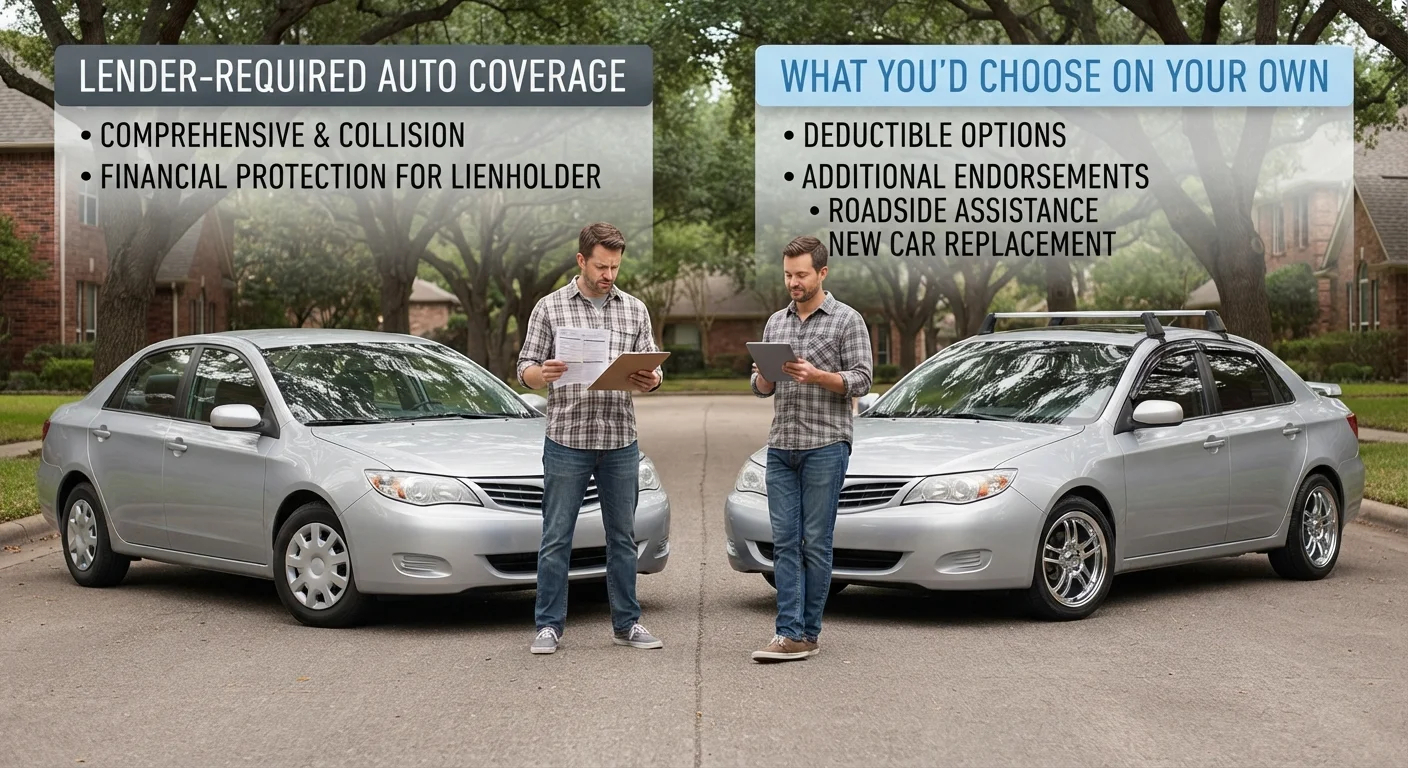
Almost every state requires drivers to carry at least a minimum amount of liability coverage. If you financed or leased your vehicle, the lender will typically require more than the state minimum. For more on that, see how lender-required coverage compares to what you'd choose independently.
This article is for general informational purposes only. Coverage terms, exclusions, and legal requirements vary by state and by insurer. Consult a licensed insurance agent for guidance specific to your situation.
Premium
The amount you pay for your insurance policy, usually monthly or every six months.
Deductible
The dollar amount you pay out of pocket on a covered claim before the insurer pays the remainder.
Liability coverage
Coverage that pays for injuries or property damage you cause to others in an accident. It does not cover your own vehicle.
Declarations page
A summary document at the front of your policy that lists your name, vehicle, coverage types, limits, and premium.
Coverage limit
The maximum dollar amount your insurer will pay for a covered claim.
Comprehensive coverage
Coverage for damage to your vehicle from events other than a collision, such as theft, weather, or fire.
The main coverage types explained
Auto policies are built from several separate coverage types. You can carry some or all of them, depending on your state's requirements, your lender's requirements, and your own financial situation.
Liability coverage
Liability coverage pays for damage and injuries you cause to other people. It is the coverage type most states require. It is usually written as three numbers, such as 25/50/25, which represent the per-person injury limit, the per-accident injury limit, and the property damage limit, all in thousands of dollars.
Collision coverage
Collision pays for repairs to your own vehicle when you hit another car or object, regardless of who caused the accident. It comes with a deductible you choose when you buy the policy.
Comprehensive coverage
Comprehensive pays for vehicle damage from events that are not collisions: theft, vandalism, hail, flooding, fire, or hitting an animal. It also carries its own deductible.
Uninsured and underinsured motorist coverage
This coverage pays your costs if the driver who hits you has no insurance or not enough to cover the damage. Many states require it; others make it optional.
Medical payments and personal injury protection
These coverages pay for medical costs for you and your passengers after an accident, regardless of who was at fault. Personal injury protection (PIP) is broader and may also cover lost wages. Some states require PIP; others do not.
How insurers set your premium
Insurers use a range of factors to calculate what you pay. Understanding those factors helps you anticipate costs and spot areas where your choices have an effect.
- Your driving record: at-fault accidents and traffic violations typically raise premiums.
- Your age and experience: newer drivers generally pay more because statistical claim rates are higher in that group.
- Your vehicle: repair costs, theft rates, and safety ratings all factor in.
- Where you live: urban areas with higher accident or theft rates usually produce higher premiums than rural ones.
- Your annual mileage: more time on the road correlates with more exposure to accidents.
- Your coverage selections and deductibles: higher deductibles lower the premium; broader coverage raises it.
Your credit history is used as a rating factor in most states, though a few prohibit it. Check your state's rules if this concerns you.
If you are also working through other financial decisions alongside buying your first car policy, a plain-language financial planning guide covers how insurance fits into a broader budget.
Gather key information before you shop
Have your driver's license number, vehicle identification number (VIN), and an estimate of your annual mileage ready before requesting quotes. Accurate information produces more reliable premium estimates and avoids surprises at policy issuance.
Reading your declarations page
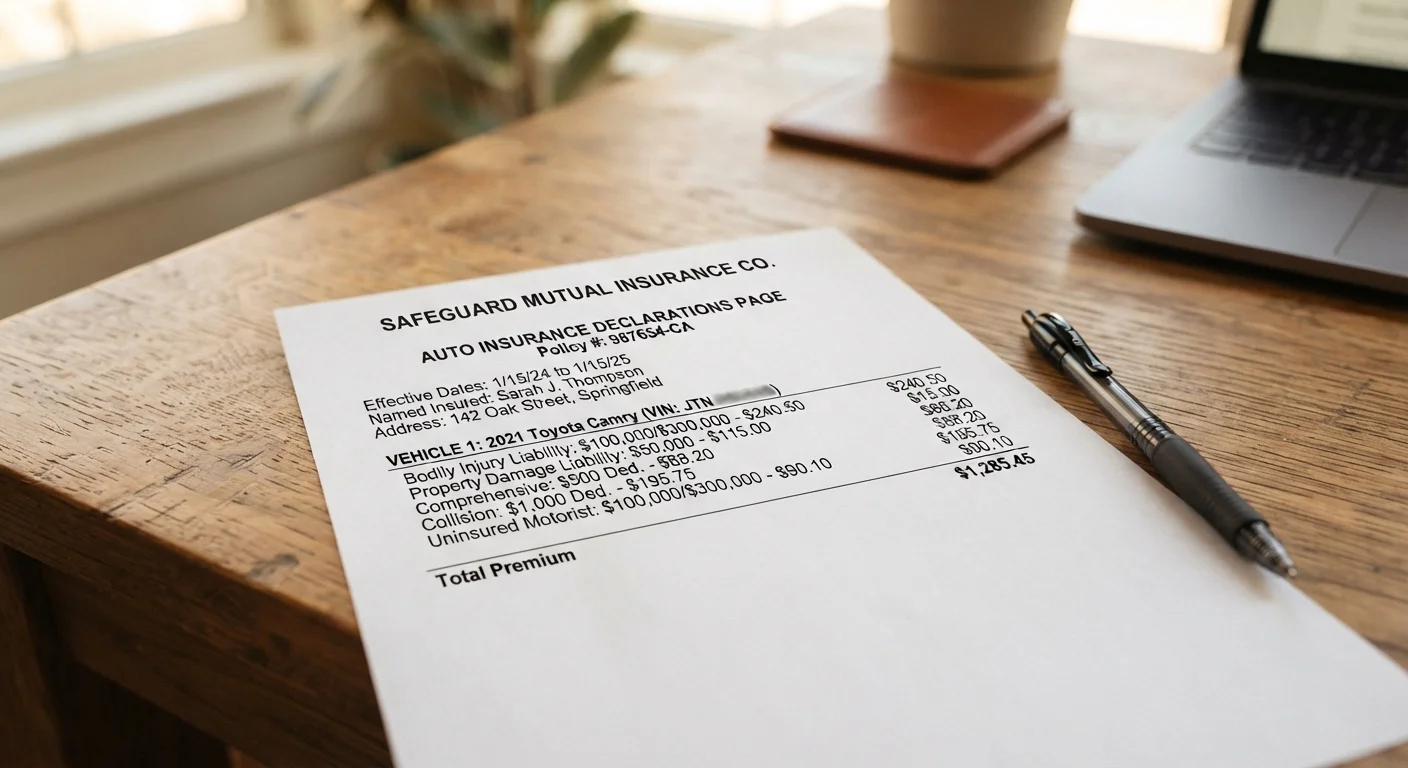
When your policy is issued, you receive a declarations page (sometimes called a "dec page"). It is a one- or two-page summary that lists the most important details of your coverage in one place.
Look for these items on your declarations page:
- Your name and the named insured (the person or people covered).
- The policy period: the start and end dates of your coverage.
- Your vehicle's year, make, model, and VIN.
- Each coverage type you purchased, with its limit and deductible.
- Your total premium and how it is broken down by coverage type.
- Any discounts applied to your policy.
The declarations page does not contain every rule and exclusion; those are in the full policy document. If anything on the dec page does not match what you agreed to when you bought the policy, contact your insurer immediately to correct it.
State minimums are a floor, not a recommendation
Every state sets its own minimum liability requirements, and those numbers are often low relative to the actual cost of a serious accident. Medical bills and vehicle repairs can exceed state minimums quickly. A licensed insurance agent can help you understand whether the minimums in your state leave a meaningful coverage gap.
What to do when you need to file a claim
Filing a claim starts with notifying your insurer, usually through a phone number or mobile app listed on your insurance card or declarations page. Report the incident promptly; most policies require timely notice.
When you report, have the following ready: the date, time, and location of the incident; the other driver's name, contact information, license plate, and insurance details if another vehicle was involved; photos of the damage; and a copy of the police report if one was filed.
Your insurer will assign a claims adjuster who assesses the damage and determines what the policy covers. You are not required to accept a settlement offer you believe is inaccurate; you can ask for a written explanation and dispute the amount through your insurer's process.
If your car is not drivable, check whether your policy includes rental reimbursement coverage, which pays for a temporary rental while your vehicle is being repaired.
For situations where you drive across state lines, coverage questions can get more complex. See how standard policies handle out-of-state travel for details.