

Why starting a financial plan matters
A financial plan is not a spreadsheet reserved for people with high incomes or investment portfolios. It is a working picture of your money: what comes in, what goes out, what you are saving toward, and what could go wrong. Without that picture, small gaps compound into larger ones over months and years.
Most Americans who feel behind on money did not make one large mistake. They simply never had a framework for making routine decisions. A plan gives you that framework. It does not guarantee outcomes, but it does give you better information to work with.
This article is general information only
The content here is educational and does not constitute personalized financial, tax, or legal advice. Everyone's financial situation is different. For decisions specific to your circumstances, consult a licensed financial adviser or other qualified professional.
Getting a clear picture of your money
Before setting any goals, gather the numbers that describe your current situation. That means your net income (what you actually take home after taxes), your fixed monthly obligations, and a reasonable estimate of your variable spending.
Pull together one to three months of bank and credit card statements. Look for recurring charges you may have forgotten, and total up what you spend in categories like housing, food, transportation, and subscriptions. This is not about judgment; it is about accuracy.
Net income
The amount of money you actually receive after taxes and other deductions are taken out of your paycheck. This is the number you use when planning a budget.
Emergency fund
A dedicated savings reserve set aside for unexpected expenses like a medical bill or car repair, so you do not need to go into debt when surprises happen.
Interest rate
The percentage a lender charges you on a loan, or a bank pays you on savings. High interest on debt means you pay significantly more than you originally borrowed.
Fixed expense
A regular cost that stays the same each month, such as rent or a car payment. These are easier to plan around than variable expenses.
Variable expense
A cost that changes from month to month, like groceries, gas, or entertainment. These are where most people find room to adjust their spending.
Credit utilization
The share of your available credit you are currently using. Keeping this percentage low generally supports a healthier credit score.
The personal budget guide walks through this process in more detail if you want a step-by-step approach to categorizing your expenses.
Building a simple budget
Once you know your income and spending, the goal is to make sure spending does not exceed income and that some portion goes toward your priorities. One common starting framework divides net income into three broad areas: needs (housing, utilities, groceries, transportation), wants (dining out, entertainment, non-essential subscriptions), and financial goals (savings and debt repayment).
The specific percentages matter less than the habit of checking in regularly. A budget that you revisit monthly is worth more than a perfect plan you abandon after two weeks.
Automate small wins early
Even a small automatic transfer to a savings account each payday builds the habit and grows the balance without requiring a decision each month. Many banks let you set this up at no cost. See how to approach financial automation for a practical overview.
Setting savings goals that stick
Savings goals are easier to follow through on when they are attached to a specific purpose and a rough timeline. Vague intentions to "save more" rarely translate into action.
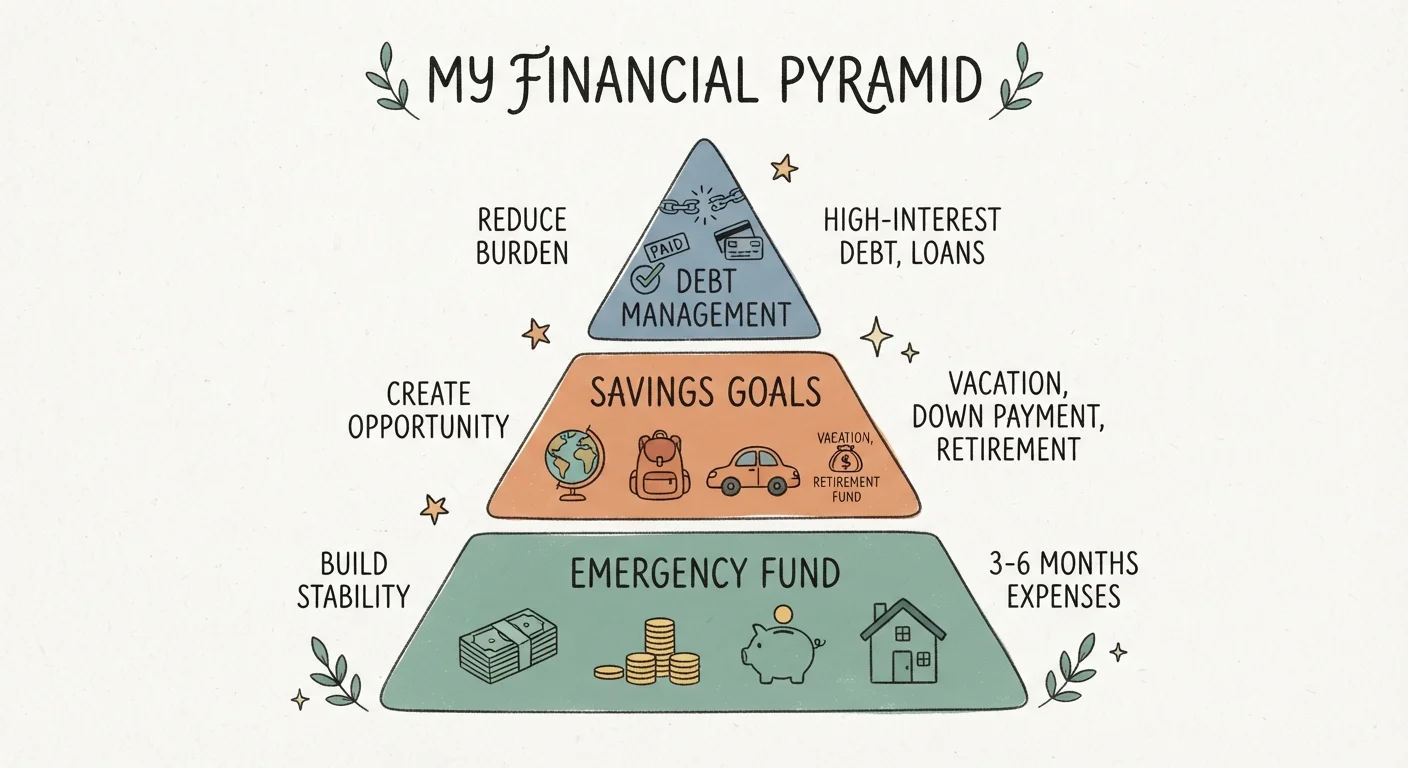
For most people starting out, the first goal is an emergency fund: a reserve of three to six months of essential expenses held in a liquid account. This buffer means that a job loss, car breakdown, or medical bill does not immediately become debt. Build this before focusing on longer-term goals like retirement contributions or a home down payment.
Once your emergency fund is in place, you can layer in goals with longer time horizons. Each goal benefits from its own named account so you can track progress clearly.
Understanding and managing debt
Debt is not automatically a problem, but high-interest debt is expensive in a way that most people underestimate. A credit card charging 20% annual interest costs you more over time than almost any savings account earns. Paying down that debt is, in effect, a guaranteed return equal to the interest rate you stop paying.
Start by listing every debt you carry: the balance, the interest rate, and the minimum monthly payment. That list tells you which debts are costing you the most and where extra payments will have the greatest impact.
Minimum payments are a slow trap
Paying only the minimum on a high-interest credit card can keep you in debt for years and cost you far more than the original purchase price. Always try to pay more than the minimum when you can, and prioritize cards with the highest interest rates.
Your credit score, which affects your ability to borrow at reasonable rates in the future, is influenced by factors including payment history and credit utilization. Paying on time and keeping balances low relative to your credit limits supports a healthy score over time.
Protecting what you build
Insurance is part of a financial plan because one large uninsured expense can erase months of careful saving. Health coverage, renter's or homeowner's insurance, and auto insurance each protect against categories of loss that could otherwise be financially catastrophic.
If you are sorting out auto coverage for the first time, the first-timer's auto insurance walkthrough explains what different coverage types mean in plain language. For health coverage options, the health coverage overview is a useful starting point.
Once you have the basics in place, a yearly review helps you confirm that your coverage, savings, and goals still match your life. The annual financial check-in checklist gives you a structured way to do that review at home.
This article is for general informational and educational purposes only and does not constitute personalized financial, tax, legal, or investment advice. Consult a licensed financial professional for guidance tailored to your individual situation.