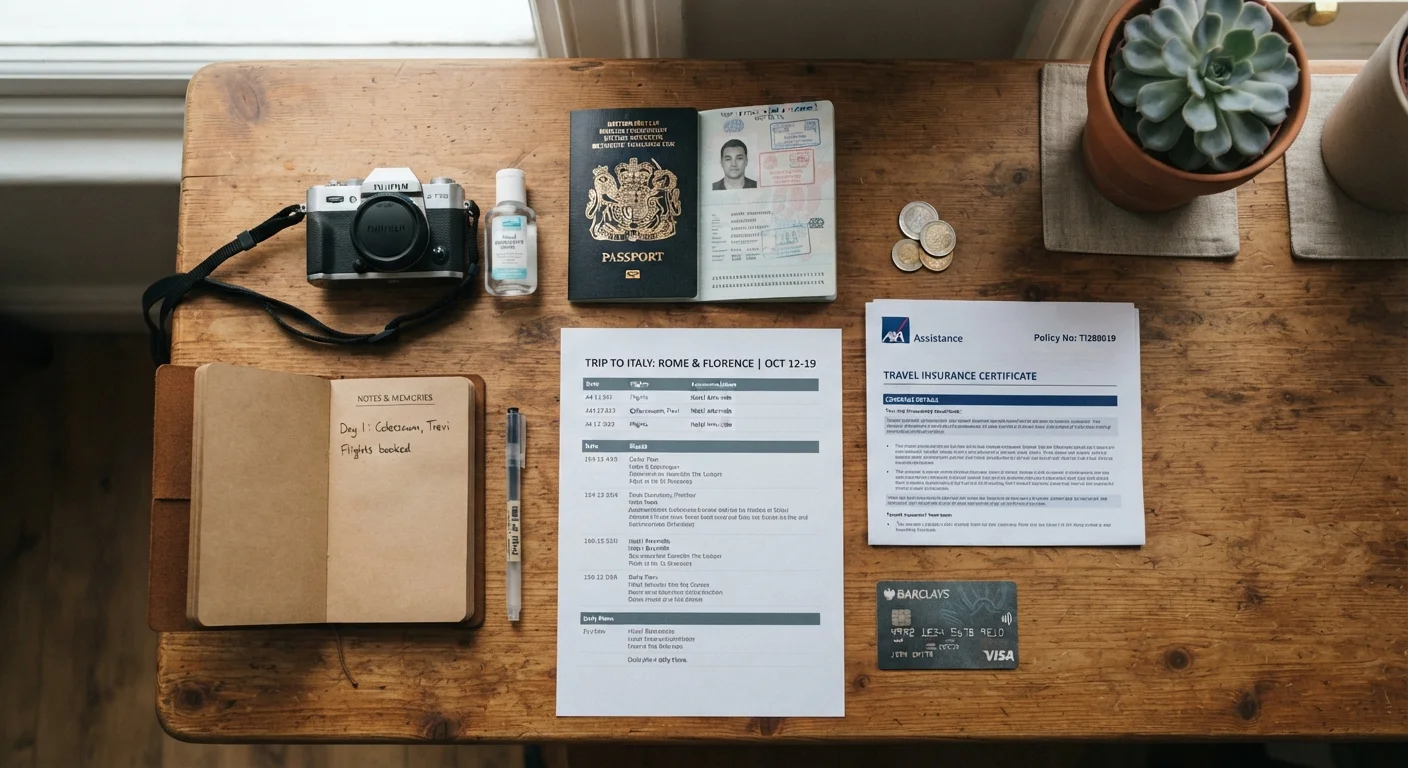

Documents you need before anything else
A valid U.S. passport is required for almost all international travel. If you do not have one, or if yours is expiring soon, start the application process well in advance. The U.S. State Department recommends applying at least six months before your departure date, and processing times can stretch longer during peak periods.
Passport validity is not just about expiration
Many countries require your passport to be valid for at least six months beyond your planned return date. A passport that is technically unexpired may still be refused at the border. Check the specific validity requirement for every country on your itinerary before you travel.
Beyond the passport itself, some countries require an additional blank page for entry stamps. Check your passport's available pages before booking, especially if you travel frequently.
For a thorough pre-trip document review, the travel planning checklist for U.S. travelers covers what to gather and confirm before you finalize any booking.
Visas, entry requirements, and official sources
Whether you need a visa depends entirely on your destination. The U.S. participates in visa-free or visa-on-arrival agreements with many countries, but others require applications submitted weeks or months in advance. Requirements also change, so a destination that was visa-free last year may not be this year.
Travel advisory
An official government warning that describes safety or entry conditions in a foreign country. The U.S. State Department rates countries on a scale from Level 1 (normal precautions) to Level 4 (do not travel).
Visa
An official permit, usually stamped or affixed to a passport, that allows a traveler to enter a specific country for a defined period and purpose.
Medical evacuation coverage
A type of insurance benefit that pays to transport a traveler to an appropriate medical facility, sometimes back to the U.S., when local care is inadequate during a health emergency.
Trip cancellation coverage
An insurance benefit that reimburses prepaid, non-refundable trip costs when you cancel for a covered reason, such as sudden illness or a family emergency.
Foreign transaction fee
A surcharge, typically 1 to 3 percent, that some banks and card issuers add to purchases made in a foreign currency or processed by a foreign bank.
Entry requirements
The conditions a traveler must meet to be admitted to a foreign country, including passport validity, visas, proof of onward travel, or health documentation.
The U.S. State Department's country information pages at travel.state.gov and the official embassy website of your destination country are the two authoritative sources to check. Travel blogs and third-party sites can be useful for general orientation, but they may not reflect the latest rules. Always confirm with official sources before booking non-refundable flights or accommodations.
Some destinations also require proof of onward travel, minimum funds, travel insurance, or specific health documentation. Read the entry requirements for each country on your itinerary, not just your first stop.
Health coverage abroad
Most U.S. domestic health insurance plans, including many employer-sponsored plans and Medicare, cover little to nothing outside the country. Some plans reimburse emergency care after the fact, but the process can involve significant paperwork and out-of-pocket costs while you wait.
Before you travel, call your insurer and ask specifically what international coverage applies to your plan. Get the answer in writing if possible. For a detailed look at how coverage gaps typically work, see how U.S. health insurance typically falls short abroad.
If your plan leaves gaps, options include travel medical insurance and travel insurance policies that include medical coverage. The CDC's Travelers' Health pages also list destination-specific vaccination recommendations worth reviewing with your doctor well before departure.
This article provides general information only. For questions about your personal health coverage or medical needs before travel, consult a licensed insurance professional and your healthcare provider.
Travel insurance basics
Travel insurance is a broad category. Policies can cover trip cancellation or interruption, emergency medical expenses abroad, emergency medical evacuation, and lost or delayed baggage. No single policy covers everything, and covered reasons for cancellation vary considerably between plans.
When reviewing a policy, look at three things: what events are covered, what is explicitly excluded, and what the claim process requires. Pre-existing medical conditions, for example, are excluded from many plans unless a waiver is purchased within a specific window after your initial trip deposit.
Timing matters. Purchasing a policy shortly after your first trip payment often unlocks benefits, like pre-existing condition waivers, that are not available if you wait. The article on when to buy travel insurance explains how the purchase date affects your coverage options.
Insurance terms, coverage, and eligibility vary by provider and policy. Read your policy document in full and consult a licensed insurance agent for guidance specific to your circumstances.
Money, currency, and budgeting abroad
Using a U.S. debit or credit card abroad is straightforward in many countries, but fees can accumulate. Foreign transaction fees, ATM withdrawal fees, and unfavorable exchange rates all reduce what your money buys. Some card issuers waive foreign fees; check with your bank before you travel.
Notify your bank and credit card companies of your travel dates before you leave. Without that notice, international transactions may trigger fraud alerts and result in a blocked card at an inconvenient moment.
Carrying a small amount of local currency when you arrive is practical. Currency exchange at airports is generally less favorable than at local banks or ATMs in the destination country, though this varies. For broader context on managing travel finances alongside your overall financial picture, the beginner's guide to financial planning covers budgeting fundamentals that apply here as well.
Safety, advisories, and staying informed
Use the State Department's STEP program
The Smart Traveler Enrollment Program (STEP) at step.state.gov lets U.S. citizens register trips with the nearest U.S. embassy or consulate. In an emergency, that registration can help consular staff locate and assist you. It is free and takes only a few minutes to set up.
The U.S. State Department publishes travel advisories for every country, rated on a four-level scale from normal precautions to do not travel. These advisories reflect crime, terrorism, civil unrest, health conditions, and natural disasters. Check the current advisory for your destination before booking and again closer to your departure date, since conditions change.
The State Department also maintains country-specific pages with information on local laws, emergency contact numbers for U.S. embassies and consulates, and entry requirements. Saving the local U.S. embassy address and phone number before you arrive is a straightforward precaution.
For travelers with health conditions or those visiting destinations with specific disease risks, the CDC's Travelers' Health portal lists health notices and vaccination recommendations by country. Discuss those recommendations with your doctor at least four to six weeks before travel, as some vaccines require time to take effect.