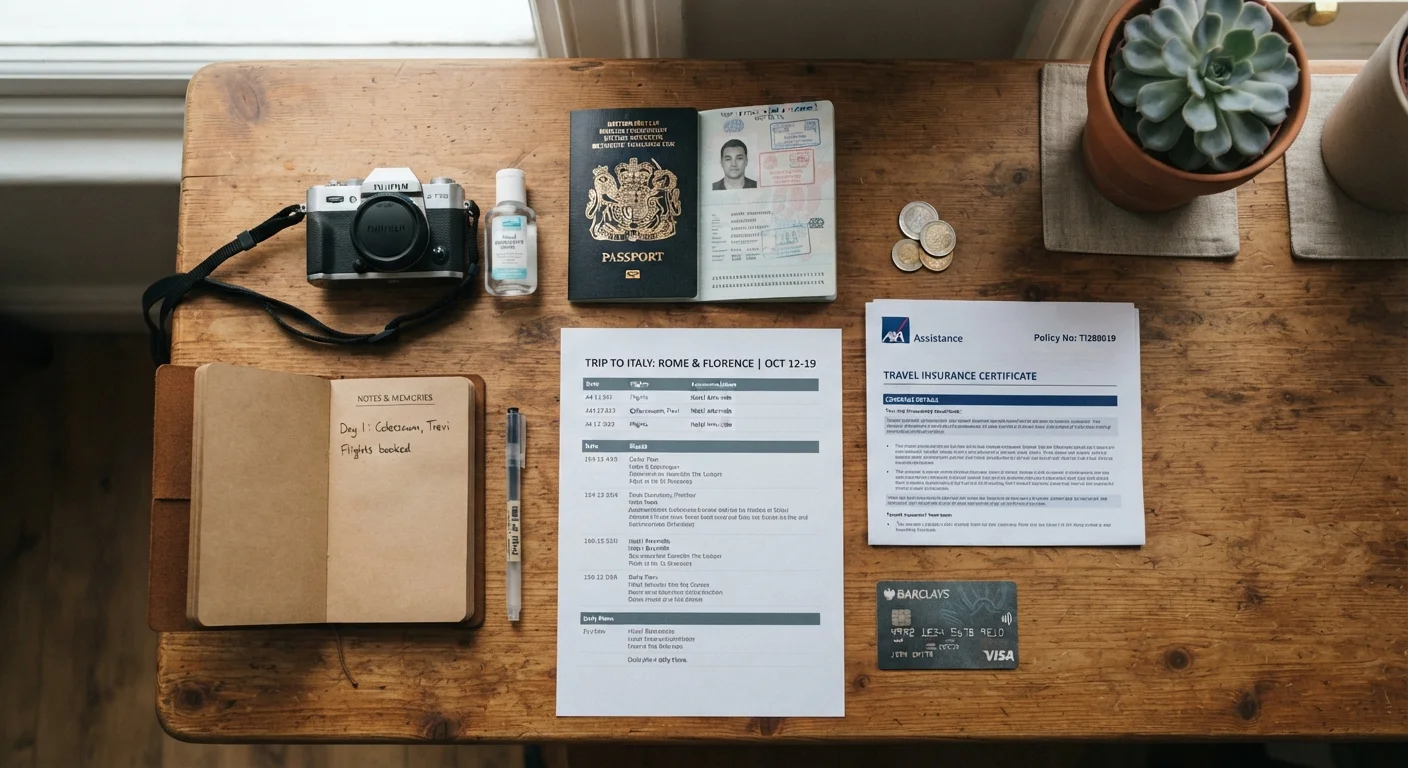
From passports to emergency contacts, use this checklist to make sure nothing important slips through the cracks before your next trip.
Key Takeaways
Check passport expiration at least six months before your departure date, not just your travel dates.
Travel insurance timing matters: some coverage types are only available if you buy within days of your first trip deposit.
Confirm whether your existing health insurance covers you abroad before assuming it does.
Save emergency contacts, your insurer's claim line, and your itinerary in at least two places.
Entry requirements such as visas and vaccinations vary by destination and can change; verify with official government sources before booking.
Why a checklist before booking matters
Most trip problems that can be avoided are not avoided because travelers discover the gap too late: an expired passport, a visa requirement they did not know about, or a travel insurance policy purchased after a cancellation event had already begun. Working through a structured checklist before you pay any deposits puts you in a position to fix those gaps while you still have options.
This checklist covers four categories: travel documents and entry requirements, health and medical preparation, financial and insurance protection, and emergency readiness. Each item is flagged as must (non-negotiable), should (strongly recommended), or nice to have (optional but useful).
For a broader look at how trip protection fits into your overall financial picture, see the annual financial check-in checklist, which includes insurance and coverage as part of a full self-audit.
Travel documents and entry requirements
Check that your passport is valid for at least six months beyond your return date, since many countries require this margin even if the U.S. does not.Must
Verify visa requirements for your destination through the U.S. Department of State website and apply early, as processing times vary widely.Must
Make two copies of your passport photo page and store one separately from your passport, and leave one copy with a trusted contact at home.Must
Check whether your destination requires proof of onward travel or a return ticket at entry.Should
Download or print your itinerary, hotel confirmations, and transportation bookings so you have access without cell service.Should
Health and medical preparation
Visit a travel medicine clinic or your primary care provider at least four to six weeks before departure to ask about destination-specific vaccinations or health precautions.Must
Verify with your health insurer whether your current plan covers emergency medical care abroad, and get confirmation in writing.Must
Carry an adequate supply of any prescription medications in original labeled containers, and bring documentation from your prescriber.Must
Check the CDC Travelers' Health website for any health advisories or recommended precautions for your destination.Should
Research the location of hospitals or clinics near your accommodations in case of a medical need.Should
Financial and insurance protection
Notify your bank and credit card issuers of your travel dates and destinations to prevent fraud blocks on your cards.Must
Review what travel protections, if any, your credit cards already include, such as trip cancellation or lost luggage coverage, before purchasing a separate policy.Must
Purchase travel insurance shortly after making your first trip deposit to access the widest range of coverage options, including pre-existing condition waivers where applicable.Must
Read your travel insurance policy document before departure so you understand what is covered, what requires pre-authorization, and how to file a claim.Must
Confirm you have a small amount of local currency or a plan for obtaining it upon arrival, since some destinations have limited card acceptance.Should
Emergency readiness
Save your travel insurer's 24-hour emergency assistance number in your phone and write it in your travel documents.Must
Share your full itinerary and accommodation addresses with at least one trusted contact at home.Must
Enroll in the U.S. Department of State's Smart Traveler Enrollment Program (STEP) if traveling internationally, so the nearest embassy can reach you in an emergency.Should
Identify the address and contact information for the nearest U.S. embassy or consulate at your destination before you depart.Should
How to use this checklist effectively
Work through each group at least four to six weeks before your departure date. Some items, particularly passport renewal and visa applications, can take several weeks to process. Starting early gives you room to handle delays without paying expedite fees.
Reviewing your documents before departure takes minutes and can prevent costly delays at the border.
For international travel, verify every entry requirement directly with the U.S. Department of State travel website and the official embassy or consulate of your destination country. Requirements change, and third-party summaries may not reflect the most current rules.
Visa rules, vaccination requirements, and border policies are set by individual countries and can be updated at any time. Do not rely on information from travel blogs or booking platforms as your final source. Always confirm current requirements directly with the destination country's embassy or official government site and the U.S. Department of State before you book or depart.
On the insurance side, timing is one of the most consequential decisions you will make. Purchasing travel insurance shortly after your first trip deposit, rather than close to departure, can unlock coverage types such as pre-existing condition waivers and cancel-for-any-reason upgrades that are not available later. The travel insurance timing guide explains how those windows work. Common purchase mistakes are covered in assumptions that can backfire when buying travel insurance.
This article is for general informational purposes only and does not constitute financial, insurance, legal, or medical advice. Coverage terms, entry requirements, and health recommendations vary by destination, provider, and individual circumstances. Verify all requirements with official government and provider sources before you travel, and consult a licensed insurance agent or qualified professional for guidance specific to your situation.
Travel Editorial Team is the collective byline for our editorial team and contributor network. Articles published under this byline or an editorial pen name are researched, written, and reviewed according to our editorial standards for clarity, consistency, and independence before publication.
The content provided on our blog site traverses numerous categories, offering readers valuable and practical information. Readers can use the editorial team’s research and data to gain more insights into their topics of interest. However, they are requested not to treat the articles as conclusive. The website team cannot be held responsible for differences in data or inaccuracies found across other platforms. Please also note that the site might also miss out on various schemes and offers available that the readers may find more beneficial than the ones we cover.