
What each plan type is
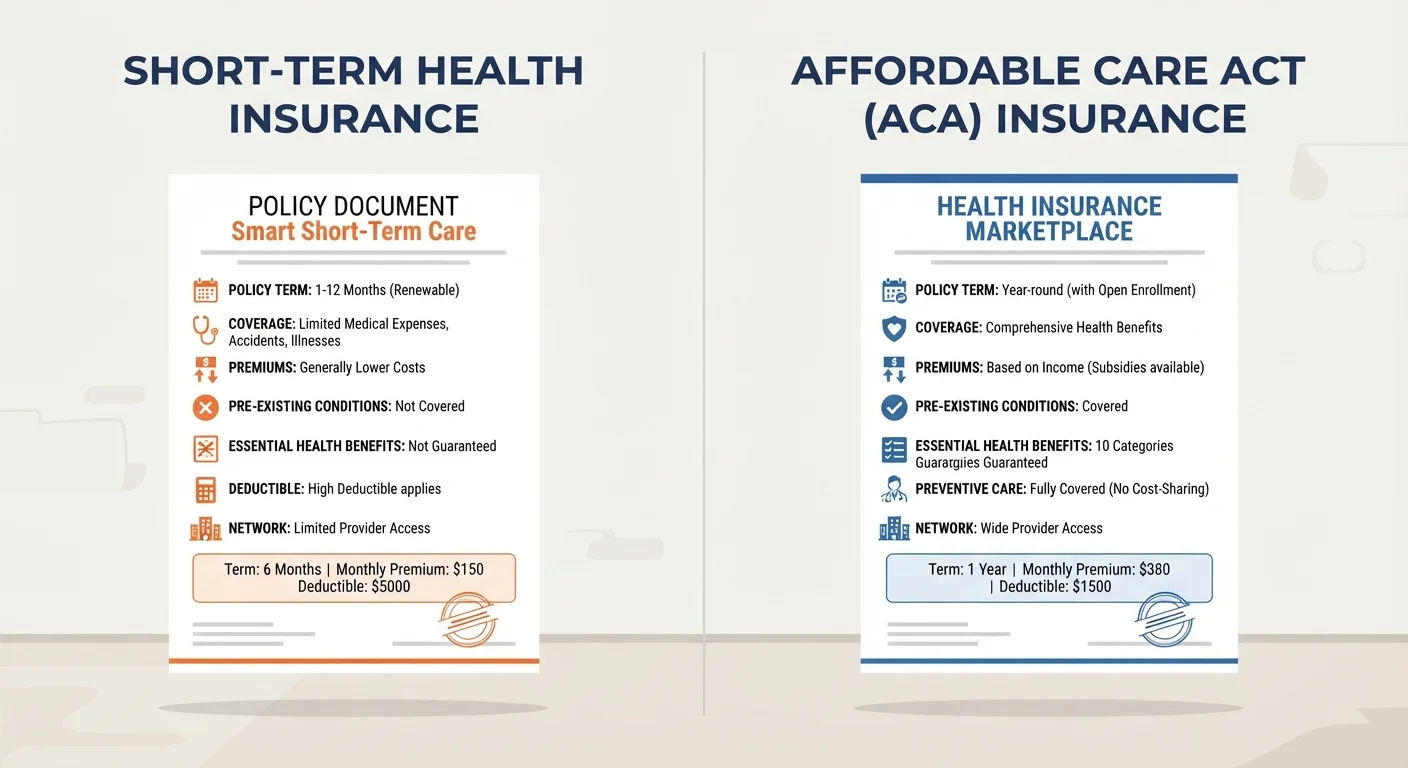
An ACA Marketplace plan is health insurance sold through the federal or a state-run exchange created by the Affordable Care Act. Every plan sold on the Marketplace must meet a defined set of federal standards. A short-term health plan (sometimes called short-term limited-duration insurance, or STLDI) is a separate product designed to fill temporary gaps in coverage. It is not required to meet those same federal standards.
If you are new to health insurance terminology, the plain-English guide for first-time shoppers covers premiums, deductibles, and networks before you compare plan types.

Coverage: what each plan must include
ACA plans must cover ten categories of essential health benefits, including emergency services, hospitalization, prescription drugs, maternity care, mental health services, and preventive care. Preventive services such as recommended screenings and vaccines must be covered without cost-sharing on most ACA plans.
Short-term plans face no comparable federal requirement. A short-term plan may exclude prescription drug coverage, mental health treatment, maternity care, or care for any condition the applicant had before the policy began (a pre-existing condition exclusion). What a short-term plan covers depends entirely on the policy document, which varies by insurer and state.
| Feature | ACA Marketplace plan | Short-term health plan | |
|---|---|---|---|
| Essential health benefits required | Yes, all 10 categories | No requirement | |
| Pre-existing condition coverage | Guaranteed, cannot be excluded | May be excluded by underwriting | |
| Out-of-pocket maximum | Federally capped each plan year | Not federally required | |
| Eligible for premium tax credits | Yes, if income qualifies | No | |
| Maximum plan duration | Annual, renewable during open enrollment | Under 12 months; up to 36 months total federally | |
| Guaranteed issue (cannot be denied) | Yes | No, medical underwriting permitted | |
| Preventive care without cost-sharing | Required on most plans | Not required |
Eligibility and consumer protections
ACA plans are guaranteed issue: insurers cannot deny an application or charge more based on health history. Short-term plans can use medical underwriting, meaning an insurer can decline to cover an applicant or exclude specific conditions.
ACA plans also cap total out-of-pocket costs each year. The out-of-pocket maximum is the most a covered person will pay for in-network care in a plan year; the insurer pays 100% of covered costs beyond that limit. Short-term plans may set their own limits or none at all, leaving enrollees exposed to uncapped costs for a serious illness.
For readers approaching age 65, the comparison of Medicare and Marketplace plans addresses how these protections interact with Medicare eligibility.
Cost and duration
Short-term plans typically carry lower monthly premiums than ACA plans, which is their main appeal. The lower premium reflects the narrower coverage, the ability to exclude high-cost applicants, and the absence of the benefit requirements ACA plans must meet.
Federally, short-term plans are limited to an initial term of less than 12 months, with a maximum total duration (including renewals) of 36 months. Several states impose shorter limits or ban short-term plans entirely, so available options depend on where a person lives.
ACA plan premiums can be reduced through premium tax credits, which are income-based subsidies. Enrollees with incomes between 100% and 400% of the federal poverty level have historically qualified, and eligibility rules have changed over time. The guide to subsidies and cost-sharing reductions explains how those calculations work.
Short-term plans are not eligible for premium tax credits.
When a short-term plan may or may not be appropriate
Check your state rules before enrolling
Short-term plan regulations differ significantly by state. Some states cap terms at 3 or 6 months, require specific disclosures, or prohibit short-term plans altogether. Your state insurance commissioner's website is the most reliable source for current rules in your location.
Short-term coverage is sometimes used during a gap between jobs, after aging off a parent's plan, or while waiting for employer coverage to begin. For a generally healthy person who understands the exclusions and needs temporary protection against a catastrophic event, the lower premium can be a practical choice.
Short-term plans are a poor fit when a person has ongoing prescriptions, a chronic condition, or expects to need mental health, maternity, or specialist care. Because pre-existing condition exclusions are common, a claim related to a prior diagnosis may be denied. Reading the policy's exclusions section before enrolling is the clearest way to understand actual coverage.
For anyone comparing individual market options more broadly, the side-by-side look at employer-sponsored and individual market plans provides additional context on how plan sources differ.
This article is for general informational purposes only and is not personalized insurance, financial, or medical advice. Coverage terms, eligibility, and regulations vary by state and insurer. Read policy documents carefully and consult a licensed insurance agent or adviser before making enrollment decisions.