
Why health insurance feels confusing at first
Health insurance documents are full of terms that look like plain English but carry specific, technical meanings. "Premium" and "deductible" sound familiar, yet many first-time shoppers discover mid-year that those words do not mean what they assumed. That gap between assumed meaning and actual meaning is where unexpected bills come from.
This guide works through the core concepts in the order you will encounter them: what you pay each month, what you pay when you use care, what kinds of plans exist, and how networks affect your costs. For a fuller reference list, see the health insurance terminology glossary.
This article is general education, not personal advice
Health insurance rules, costs, and eligibility vary by state, employer, and individual circumstances. Nothing here constitutes personalized insurance, financial, or medical advice. A licensed insurance professional can help you evaluate options specific to your situation.
The costs you pay: premiums, deductibles, copays, and coinsurance
Health insurance involves two distinct buckets of costs. The first is the premium, paid monthly whether or not you see a doctor. The second covers what you pay at the point of care.
Premium
The monthly amount you pay to maintain health insurance coverage, separate from any costs you pay when you actually use care.
Deductible
The amount you pay for covered services before your insurance company begins sharing costs. For example, with a $1,500 deductible, you pay the first $1,500 of covered care each year.
Copay
A fixed dollar amount you pay for a specific service, such as a doctor visit, at the time of care.
Coinsurance
Your share of a medical bill expressed as a percentage, paid after you have met your deductible. For example, 20% coinsurance means you pay one-fifth of covered costs.
Out-of-pocket maximum
The most you will pay for covered services in a single plan year. After reaching this limit, the insurer pays 100% of covered costs for the remainder of the year.
Formulary
The list of prescription drugs a health plan covers. Drugs on the formulary are covered at set cost-sharing rates; drugs off the list may not be covered at all.
Network
The group of doctors, hospitals, and other providers that have contracts with your insurance company. Using in-network providers costs less than going outside the network.
Health Savings Account (HSA)
A tax-advantaged savings account available to people enrolled in a qualifying high-deductible health plan, used to pay for eligible medical expenses.
Once you meet your deductible, the plan begins sharing costs with you through copays or coinsurance. A copay is a flat fee: you might pay $25 for a primary care visit regardless of what the doctor charges. Coinsurance is proportional: if your plan has 20% coinsurance, you pay one-fifth of the allowed amount for a covered service and the insurer pays the other four-fifths.
Both copays and coinsurance accumulate toward your out-of-pocket maximum. When you reach that ceiling, the insurer covers 100% of covered services for the rest of the plan year. Some services, such as preventive care, are covered at no cost under ACA-compliant plans even before you meet your deductible.
Check both premium and total potential cost
A low monthly premium does not always mean lower overall spending. Add the annual premium to the out-of-pocket maximum to estimate the most you could pay in a year. Comparing this figure across plans gives a clearer picture than comparing premiums alone.
Plan types: HMO, PPO, EPO, and HDHP
The four plan types you will see most often differ primarily in how much freedom you have to choose providers and whether you need referrals.
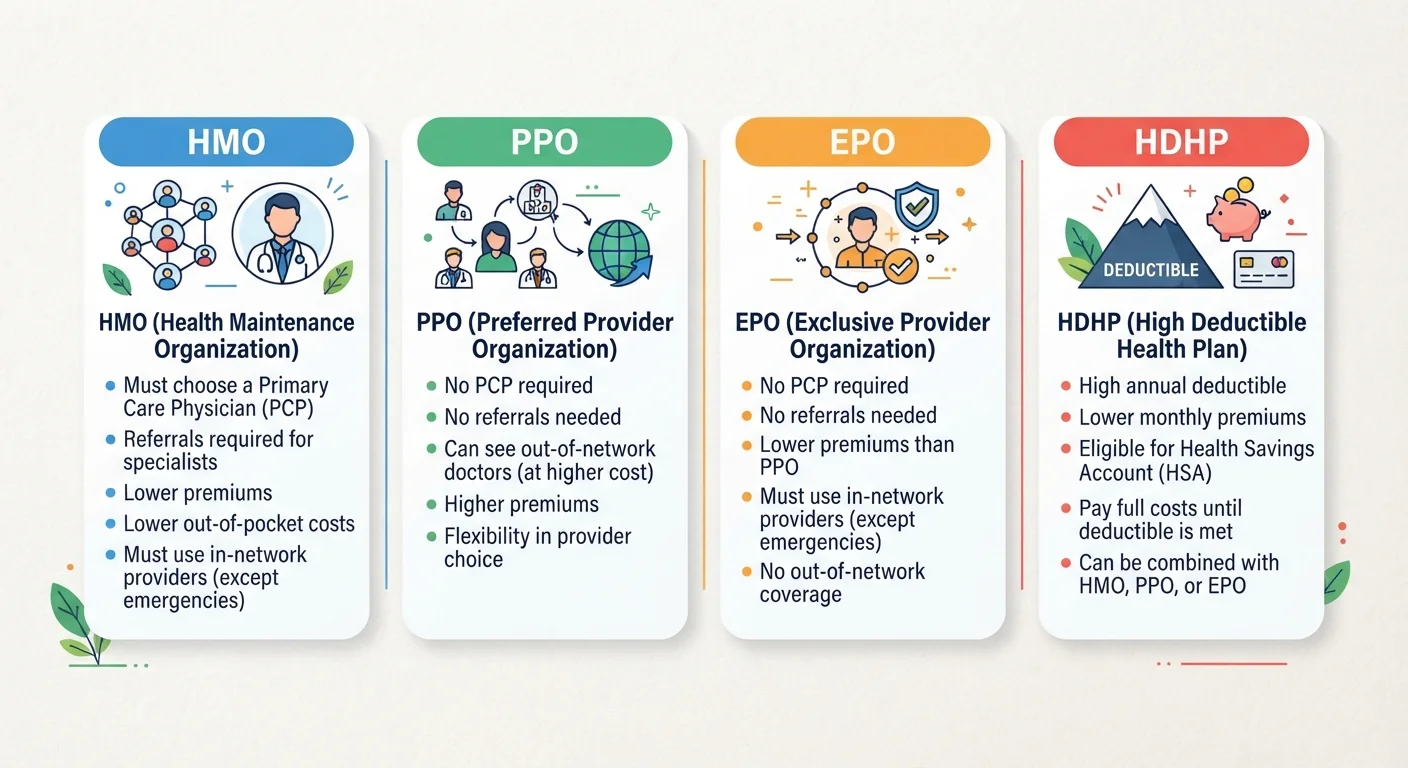
- An HMO (Health Maintenance Organization) requires you to choose a primary care physician who coordinates your care and provides referrals to specialists. Coverage is generally limited to in-network providers except in emergencies.
- A PPO (Preferred Provider Organization) lets you see any provider without a referral, in-network or out-of-network, though out-of-network care costs more. PPOs tend to carry higher premiums than HMOs.
- An EPO (Exclusive Provider Organization) combines features of both: no referrals needed, but coverage is restricted to in-network providers, as with an HMO.
- An HDHP (High-Deductible Health Plan) has a higher deductible than conventional plans but a lower premium. When paired with a Health Savings Account (HSA), contributions to the account are tax-advantaged and can be used for qualified medical expenses.
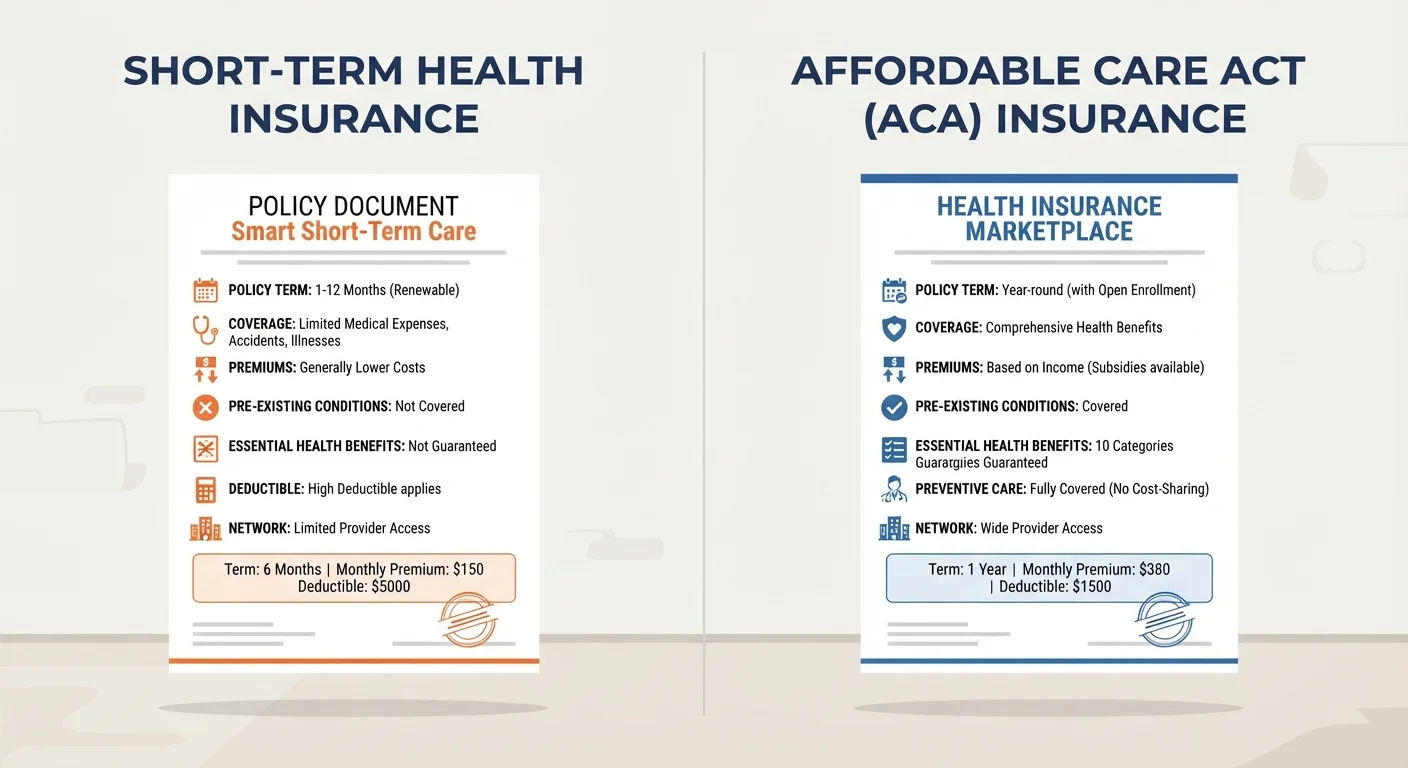
For a detailed comparison of ACA-compliant plans versus short-term options, see short-term plans vs. ACA plans.
Networks and why they matter
A network is the set of providers that have agreed to negotiated rates with a specific insurer. Those rates are lower than what an uninsured patient would pay, and your cost-sharing applies to them. Outside the network, an insurer may pay little or nothing, leaving you responsible for a larger share or the full bill.
Out-of-network costs can be much higher
Using an out-of-network provider can result in bills far beyond what you would pay in-network, and those costs may not count toward your in-network deductible or out-of-pocket maximum. Always confirm a provider's network status before an appointment when possible.
Before enrolling in a plan, check whether your current doctors, any specialists you see regularly, and your preferred hospital are in that plan's network. Insurers post provider directories online, though those directories can lag behind real-world changes. Calling the provider's office directly to confirm network status is a reliable extra step.
Prescription drug coverage works similarly. Each plan maintains a formulary, its list of covered drugs arranged in tiers. Higher-tier drugs carry higher cost-sharing. If you take a specific medication regularly, confirm it appears on the formulary before choosing a plan.
Where to get coverage
Most Americans get health insurance through an employer, through a government program such as Medicaid or Medicare, or through the ACA Marketplace at HealthCare.gov. If your employer offers coverage, the employer-sponsored vs. individual plan comparison can help you weigh that against Marketplace options.
ACA Marketplace plans are sold in four metal tiers: Bronze, Silver, Gold, and Platinum. The tiers reflect how costs are split between you and the insurer across a year, not the quality of care. Bronze plans carry lower premiums and higher cost-sharing; Platinum plans carry higher premiums and lower cost-sharing. Income-based premium tax credits may reduce what you pay for a Marketplace plan.
Enrollment periods are time-limited. Open enrollment for Marketplace plans runs each fall. Outside that window, a qualifying life event such as losing job-based coverage, getting married, or having a child can trigger a Special Enrollment Period. Missing enrollment windows can leave you uninsured until the next open period.
Once you have a plan, understanding where coverage stops matters as much as knowing what it includes. The common coverage gaps article covers services and situations that frequently catch enrollees off guard.
This article is for general informational purposes only and does not constitute personalized insurance, financial, or medical advice. Coverage terms, costs, and eligibility vary by plan, state, and individual circumstances. Consult a licensed insurance professional for guidance specific to your situation.