

Why terminology matters before you enroll
Health insurance applications and plan comparison tools use terms that carry specific, technical meanings. Reading a plan without knowing those meanings makes it hard to judge whether a lower premium actually saves money or simply shifts costs elsewhere. This glossary covers the terms you are most likely to encounter during open enrollment or a special enrollment period.
For a broader orientation to the shopping process, see Health Insurance Decoded: A Plain-English Guide for First-Time Shoppers.
Premium
The monthly amount you pay to maintain health insurance coverage. Premiums are owed regardless of whether you use any medical services during the month.
Deductible
The amount you pay out of pocket for covered services each plan year before your insurer begins sharing costs. Some services may be covered before this threshold is met.
Coinsurance
The percentage of covered costs you pay after meeting your deductible. For example, 20% coinsurance means you pay 20% and your plan pays 80% of the covered amount.
Out-of-pocket maximum
The most you will pay in cost-sharing during a plan year. After reaching this limit, your insurer pays 100% of covered in-network services for the remainder of the year.
Copay
A fixed dollar amount you pay for a covered service or prescription at the time of the visit or purchase, such as $30 for a primary care appointment.
Actuarial value
A percentage indicating how much of covered medical costs a plan pays on average for a standard population. ACA metal tiers (Bronze through Platinum) are defined by actuarial value ranges.
Formulary
The list of prescription drugs covered by a health plan. Drugs are grouped into tiers that determine how much you pay. Drugs not on the formulary may not be covered.
Prior authorization
A requirement that your insurer approve certain services or medications before you receive them. Without approval, claims for those services may be denied.
Network
The group of doctors, hospitals, and other providers that have contracted with an insurer to provide services at agreed rates. In-network care typically costs less than out-of-network care.
EOB (Explanation of Benefits)
A document from your insurer showing what was billed for a claim, what the plan paid, and what you owe. It is a summary, not a bill.
HSA (Health Savings Account)
A tax-advantaged account available to people enrolled in a qualifying high-deductible health plan. Funds can be used to pay qualified medical expenses.
Special enrollment period
A window outside the standard open enrollment period during which you may sign up for or change health coverage, usually triggered by a qualifying life event such as job loss or marriage.
Cost-sharing: how you and your plan split the bill
Cost-sharing describes the portion of a covered service that you pay directly, as opposed to what your insurer pays. Four terms define most cost-sharing structures.
The deductible is the amount you pay out of pocket each plan year before the insurer begins covering most services. A plan with a $2,000 deductible means you pay the first $2,000 of covered medical costs yourself. Some services, such as preventive screenings, may be covered before the deductible is met, depending on the plan.
The copay is a fixed dollar amount you pay at the time of a visit or when filling a prescription, for example $30 for a primary care appointment. Copays are usually set regardless of the total cost of the service.
Coinsurance is a percentage split that takes effect after you have met your deductible. If your coinsurance is 20%, you pay 20% of covered costs and your plan pays 80%.
The out-of-pocket maximum caps the total you pay in cost-sharing within a plan year. After you reach it, the insurer pays 100% of covered in-network services for the rest of the year. For 2024, the ACA set federal limits on out-of-pocket maximums for marketplace plans.
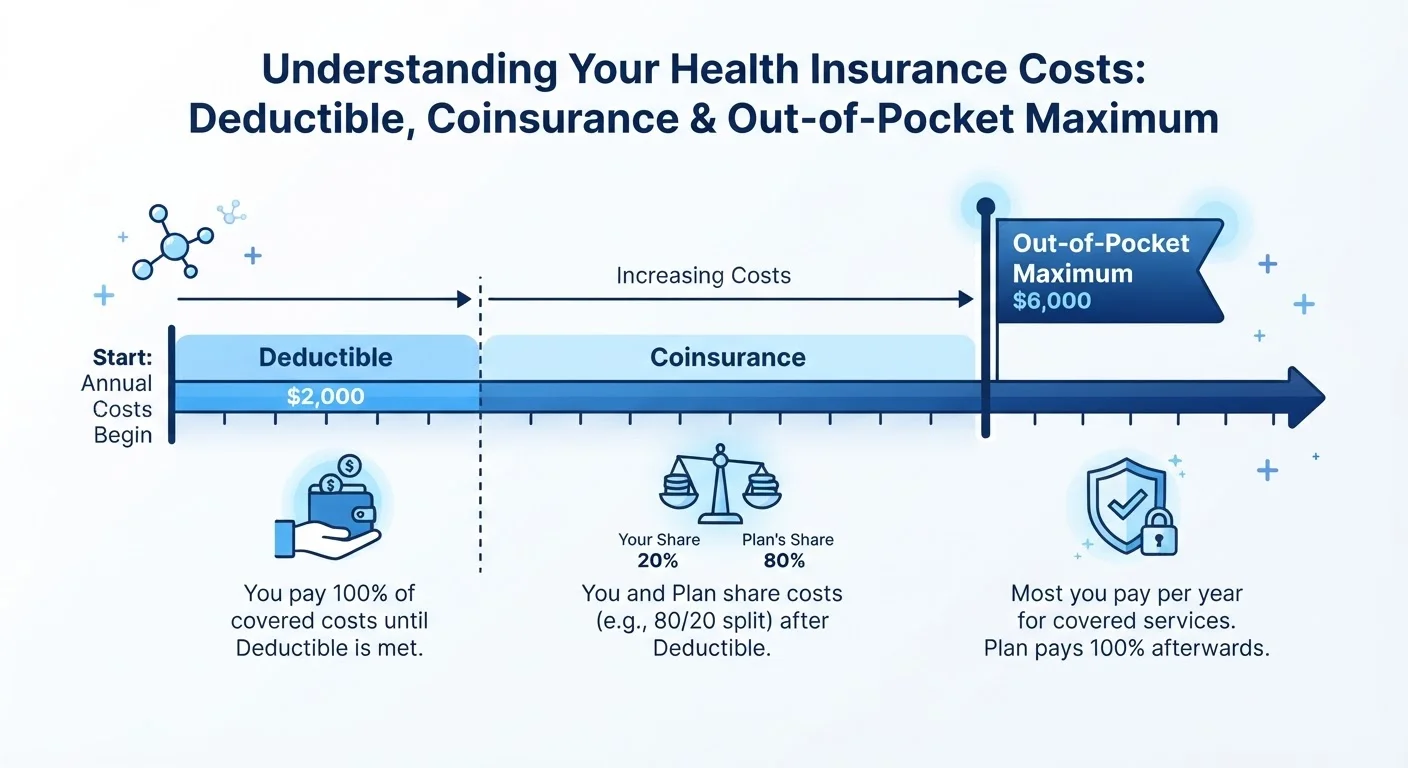
For a detailed look at how these three elements interact, see Deductibles, Copays, and Coinsurance: Where Your Out-of-Pocket Costs Actually Come From.
Plan structure and network terms
Health plans organize care through networks of doctors, hospitals, and other providers that have agreed to contracted rates with the insurer. Staying in-network almost always costs less than going out-of-network, and some plan types do not cover out-of-network care at all except in emergencies.
An HMO (Health Maintenance Organization) requires you to choose a primary care physician (PCP) who coordinates your care and provides referrals to specialists. HMOs generally have lower premiums but restrict you to in-network providers.
A PPO (Preferred Provider Organization) gives you more flexibility to see specialists and out-of-network providers without a referral, though out-of-network care costs more. Premiums for PPOs tend to be higher than for HMOs.
An EPO (Exclusive Provider Organization) combines elements of both: no referrals needed, but coverage is limited to the plan's network. An HDHP (High-Deductible Health Plan) pairs a higher deductible with a lower premium and may be paired with a Health Savings Account (HSA), a tax-advantaged account you can use to pay qualified medical expenses.
| HMO referral required | Yes, to see a specialist |
| PPO out-of-network coverage | Yes, at higher cost |
| EPO out-of-network coverage | No (emergencies excepted) |
| HDHP minimum deductible (2024) | $1,600 individual / $3,200 family (IRS Rev. Proc. 2023-23) |
| ACA Bronze actuarial value | Approximately 60% (CMS) |
| ACA Platinum actuarial value | Approximately 90% (CMS) |
Gaps between what a plan covers and what you actually need can appear after enrollment. Common Health Insurance Coverage Gaps to Know outlines the issues enrollees encounter most often.
Coverage and eligibility terms
The premium is the monthly amount you pay to maintain coverage, regardless of whether you use medical services that month. Premiums are separate from cost-sharing.
Actuarial value is a percentage that describes, on average, how much of covered medical costs a plan pays for a standard population. A plan with an actuarial value of 70% pays roughly 70 cents of every covered dollar on average; enrollees pay the rest through cost-sharing. ACA metal tiers (Bronze, Silver, Gold, Platinum) correspond to actuarial value ranges.
A formulary is the list of prescription drugs a plan covers. Drugs are sorted into tiers that determine your copay or coinsurance. If a medication you take is not on a plan's formulary, you may pay full price or need to request an exception.
Prior authorization means the insurer must approve certain services, procedures, or medications before you receive them in order for coverage to apply. Failing to get required authorization can result in a denied claim.
An EOB (Explanation of Benefits) is the document your insurer sends after a claim is processed. It shows what was billed, what the plan paid, and what you owe. It is not a bill, but it is worth reviewing for accuracy.
When comparing plan types across different market segments, Short-Term Health Plans Versus ACA Plans: Understanding the Differences explains how ACA protections differ from short-term plan rules.
This article is for general informational purposes only and is not medical or legal advice. Coverage terms, rules, and limits vary by insurer, plan, and state. Consult a licensed insurance agent or a qualified healthcare professional for guidance specific to your situation.