

How networks shape what you pay
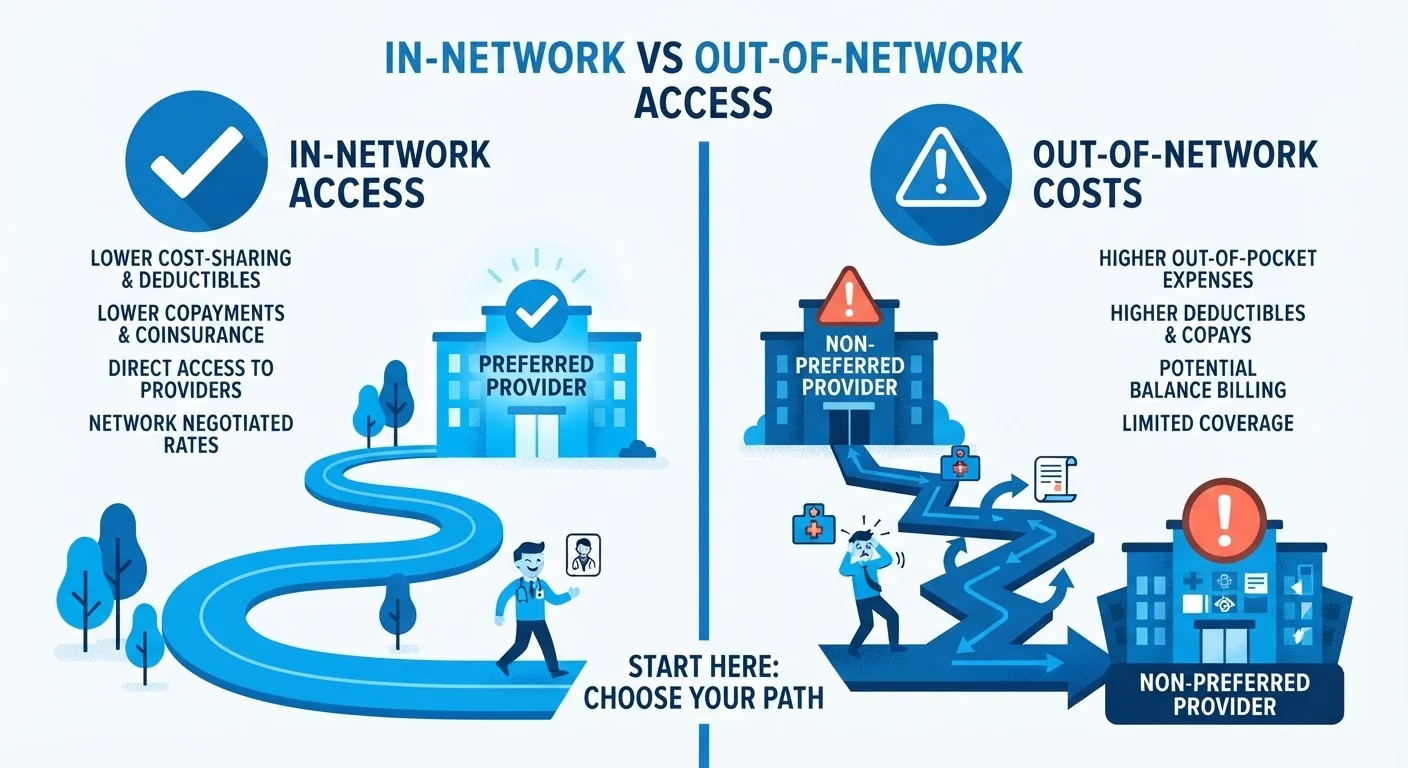
When an insurer builds a health plan, it negotiates contracts with providers. Those contracts set a discounted rate, often called an allowed amount, that the provider agrees to accept as full payment for a covered service. The insurer then applies your plan's cost-sharing terms (your deductible, copay, or coinsurance) to that lower figure.
When you use a provider outside the network, no contract exists. The provider can bill at their standard rate, your insurer may pay less or nothing, and you can be responsible for the gap. That gap is sometimes called a balance bill. The dollar difference between in-network and out-of-network costs for the same procedure can be significant.
If you are still building familiarity with terms like deductible and coinsurance, this overview of cost-sharing terms walks through how those pieces connect.
Plan types and how they handle the network
Not all plans treat out-of-network care the same way. The plan type you enroll in directly controls your flexibility.
- HMO (Health Maintenance Organization): Generally covers only in-network providers except in a medical emergency. Most HMOs also require you to choose a primary care physician who coordinates referrals to specialists.
- PPO (Preferred Provider Organization): Covers both in-network and out-of-network care, but at different cost levels. Out-of-network visits typically carry a higher deductible and coinsurance rate.
- EPO (Exclusive Provider Organization): Covers in-network care only, similar to an HMO, but usually without a referral requirement for specialists.
- POS (Point of Service): A hybrid that requires a primary care physician referral like an HMO but allows out-of-network care at a higher cost like a PPO.
Your introduction to health insurance plan types covers these structures in more depth if you are comparing options for the first time.
Network rules apply to telehealth too
Virtual visits follow the same in-network and out-of-network rules as in-person care. A telehealth provider available through a third-party app may not be in your plan's network, even if the service is offered through your insurer's portal. Confirm network status before using a telehealth service to avoid unexpected cost-sharing.
What the No Surprises Act changed
Congress passed the No Surprises Act, which took effect January 1, 2022. Under it, patients with job-based or individual market plans cannot receive a balance bill above in-network cost-sharing amounts in two main situations: emergency care at any facility, and certain non-emergency care at an in-network facility where the patient did not knowingly choose an out-of-network provider.
The law does not cover every situation. Scheduled out-of-network care you choose voluntarily, care at out-of-network facilities, and care under government programs such as Medicaid and Medicare Advantage have different rules. The Centers for Medicare and Medicaid Services (CMS) maintains current guidance on what the law covers at cms.gov.
Coverage gaps from surprise billing were among the most common complaints before the law took effect. Common gaps enrollees discover in their coverage explains other situations where plans may not cover what people expect.
Practical steps before you receive care
Provider directories published by insurers can be incomplete or slow to update. A provider listed as in-network may have recently ended their contract. Before scheduling a visit, call the provider's office and confirm they accept your specific plan and plan year, since networks can change at renewal.
When a hospital is in-network, the physicians who work there may not be. Anesthesiologists, radiologists, and emergency physicians are frequently employed by separate groups that carry different network contracts. If a procedure involves multiple providers, it is worth asking about each one before the appointment.
Your plan's Summary of Benefits and Coverage (SBC), a standardized document all plans must provide, states the in-network and out-of-network deductibles and out-of-pocket maximums side by side. Reading that document is the clearest way to understand what your specific plan covers under each scenario.
This article is for general informational purposes only and does not constitute medical or financial advice. Coverage terms, network rules, and legal protections vary by plan and state. Consult a licensed insurance professional or your plan documents for guidance specific to your situation.